CULINARY OBSERVATIONS
To eat in London and its surrounding countryside is to witness a region defined by a distinct agricultural gravity and an increasingly restless, global soul. It is a landscape where the deep-rooted vernacular of the farm meets the spiced, expansive narratives of the Black Sahel and the Mediterranean. We would begin at David’s Bistro, an enduring slice of the Left Bank on Richmond Street. Inside, the blackboard specials, including a quintessential choucroute garni, offer a soulful warmth that never goes out of style. For the morning, Billy’s Deli provides a masterclass in the classic breakfast, serving latkes that could plausibly challenge Montreal’s best.
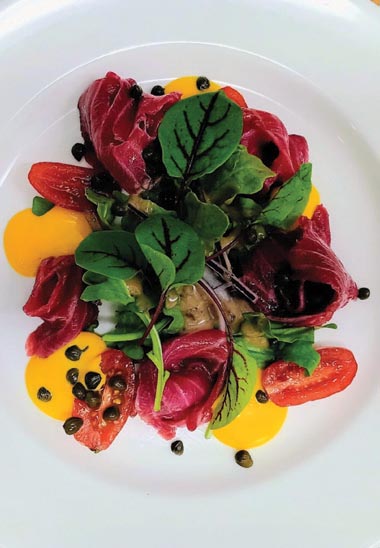
Beet-cured Salmon with saffron aioli and red vein sorrel from David’s Bistro
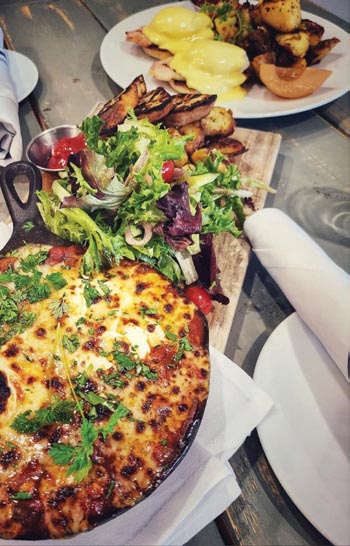
Eggs poached in stewed San Marzano tomatoes with garlic, roasted peppers & Cojita cheese from Craft Farmacy
To eat in London and its surrounding countryside is to witness a region defined by a distinct agricultural gravity and an increasingly restless, global soul.

On the weekends, the ritual shifts to Craft Farmacy, where Chef Andrew Wolwowicz anchors the room with a signature seafood tower. A short drive to St. Mary’s reveals The Flour Mill, a destination that turns “peas on toast” into a minor work of art.
A short drive to St. Mary’s reveals The Flour Mill, a destination that turns “peas on toast” into a minor work of art.
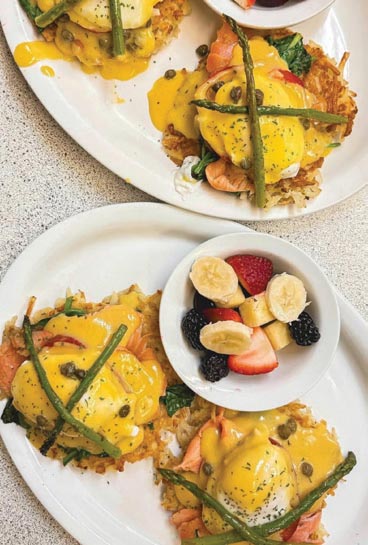
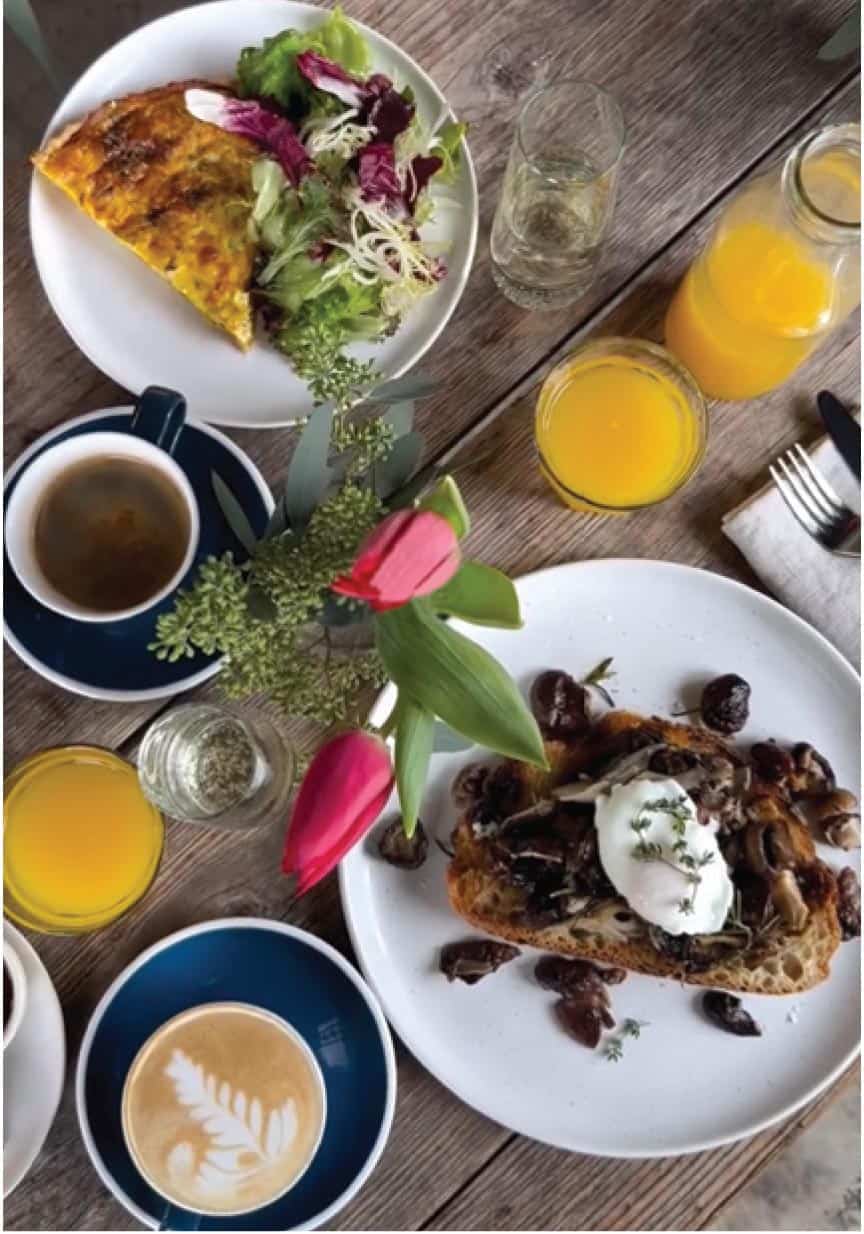
A savoury brunch table at The Flour Mill in St. Marys
Alo Chicken’s family special, whole chicken, salad, french fries, and Parisenne
potatoes, plus a side of cod cakes
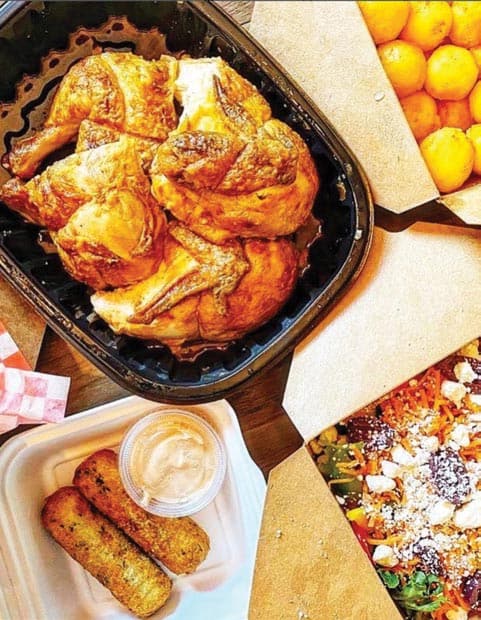
The heartbeat of this evolution remains the Covent Garden Market, a space currently reinventing itself. A state-of-the-art teaching and community kitchen is arriving on the main floor, while The Tea Haus has recently moved into a freshly renovated, larger home upstairs. Between these updates, one finds the market’s essential textures: Bhan Mudliar’s New Delhi Deli’s legendary oxtail, The Hot Oven’s flaky bureks, and Alo Chicken’s Mediterranean energy. I am also particularly excited to see Bhan, of New Delhi Deli fame, launching a new pizza venture within the market walls.
Maryam and Malvin Wright of Yaya’s kitchen curate the flavours of West Africa through tasting menus that feel like a cultural discovery.
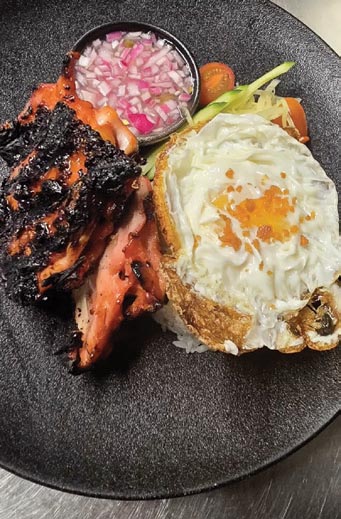
Sagi of Wortley’s Grilled Chicken Tocino with sinangag (garlic rice), fried eggs, pickled papaya and sawsawan dipping sauce
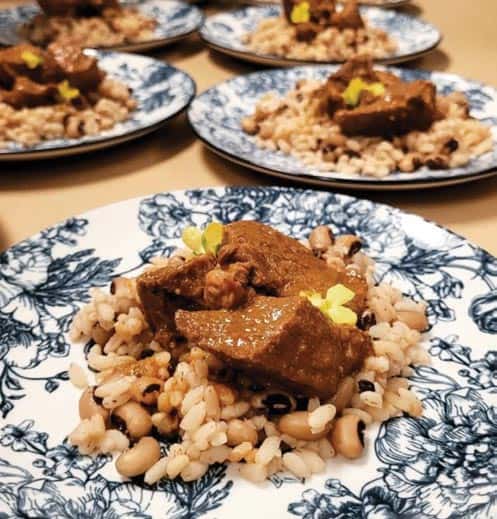
Rice and peas with braised beef and spices at Yaya’s Kitchen
The narrative deepens at Museum London, where Yaya’s Kitchen has found a stunning new home. Maryam and Malvin Wright curate the flavours of West Africa through tasting menus that feel like a cultural discovery. Nearby, TG’s Addis Ababa offers a masterclass in Ethiopian hospitality, while Rosa’s Pupuseria serves handmade Salvadoran pupusas with devotional care. At Adelaide and Hamilton Road, in the space of the original International Bakery, Kebab-Tu offers authentic Turkish hospitality and a succulent iskender kebab.
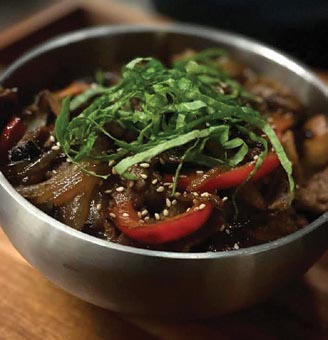
Bulgulgi Bowl with beef and glass noodles from
Mori Japanese Bar
In the neighbourhood pockets, the city feels intimate and innovative. Wortley Village serves as a creative hub, home to Sagi of Wortley’s imaginative small plates, the refined Japanese flavours of Mori Japanese Bar, and the community-driven atmosphere of Rebel Layne. We also celebrate the reopening of Ian Kennard’s Willie’s Café, a revered institution for scratch-made sandwiches and catering that remains a local essential, at its new home in One London Place.
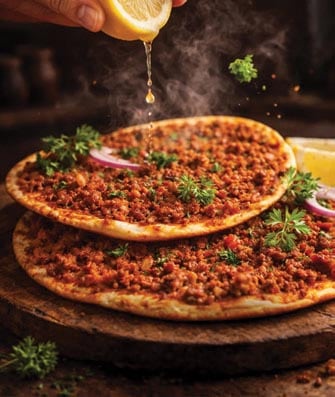
Crispy Lahmacun from Kebab-Tu
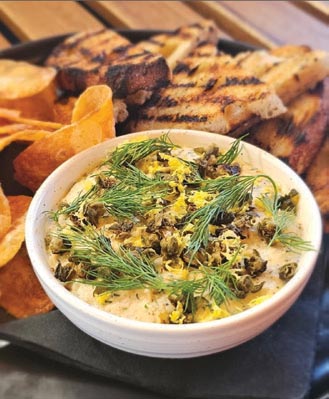
Smoked Salmon Dip ~ Served with chips and toast, garnished with fried capers, lemon zest, and fresh
dill from Rebel Layne
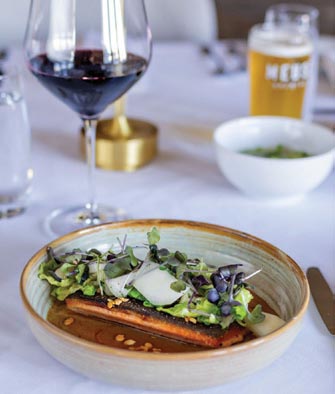
From sixthirtynine in Woodstock, Pan-seared Rainbow Trout with Brussels sprout leaves, turnip, sesame rice wine vinaigrette, 5-spice toasted peanuts,
peanut chili coconut sauce and purple diakon sprouts
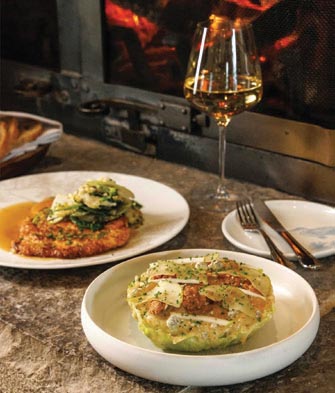
Dinner by the fire at Elora Mill Restaurant in Elora
Beyond the city limits, more refined ambition beckons. In Woodstock, sixthirtynine offers a mature synthesis of gastronomy and comfort under Chef Eric Boyar. We would stop at the Elora Mill Restaurant overlooking the Grand River Gorge, where Executive Chef Dacha Markovic presents wood-fired dishes, before reaching the “carte blanche” regenerative cooking at Restaurant Pearl Morissette in Niagara. We would inevitably end in Stratford, a town kept perpetually sharp by the influence of its Chef’s School and the reopening of Keystone Alley, alongside the exceptional tables at The Starlight and Bijou.
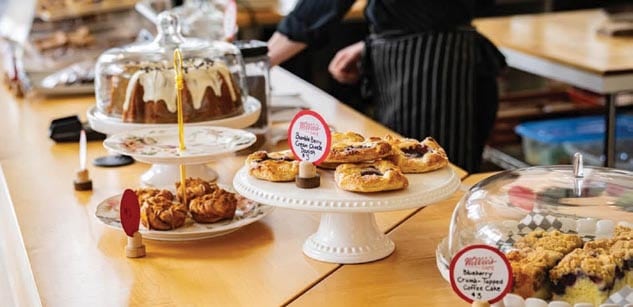
Dessert offerings at Willie’s Cafe.
My mother possessed a biological clock for the harvest that no industrial supply chain could fool.
PROVABLE LOCAL PROVENANCE
In the summer of 1989, at my first restaurant, La Cucina on King, the threshold was guarded by a sentinel more formidable than any local sourcing audit: my mother. We were situated directly across from London’s Covent Garden Market, and treated that proximity not as a convenience but as a mandate.
My mother is a woman of artistic, curated glamour, yet on our opening night, I found her on her hands and knees scrubbing the kitchen floor. With youthful arrogance, I assumed such manual devotion wouldn’t last. I was wrong; she was performing that same ritual on our final night before we sold the business. My mother possessed a biological clock for the harvest that no industrial supply chain could fool. If a crate of tomatoes arrived a week before the local vines had yielded their first heavy, sun-split fruit, she turned them away as if those mealy impostors were a personal affront to our lineage. That discipline — a fusion of creative art and hard labour — introduced me to the Slow Food principles of good, clean, and fair long before I knew the movement had a name.
A decade before I became a proponent of the Slow Food movement, I had worked at La Sabblonerie on the Channel Island of Sark, just off the coast of France. In that car-free, feudal outpost, “local sourcing” wasn’t a philosophy; it was the only option. The hotel was entirely self-sufficient, raising its own Guernsey cows for the thick cream and butter that defined the menu.
This rigid devotion has defined my philosophy as a chef and chronicler of the “ethical gourmet.” In my own kitchens, I have even attempted a total embargo on American products. It is a pursuit of purity occasionally, and perhaps inevitably, punctured; even the most dedicated ascetic might let a box of Diamond Crystal salt slip through the door, a solitary intruder in a pantry otherwise defined by local ingredients and European imports.
But today, the quiet integrity of the harvest is drowned out by a cacophony of adjectives. “Greenwashing” flourished long before menus began to groan under the weight of “artisanal” and “heirloom” — terms that now provide a thin veneer of credibility to less rigorous establishments. Among the professionals I know, a cynical axiom has taken hold: the more adjectives a menu employs, the less impressive the plate.
We have entered the era of farmwashing, where restaurants lean into pastoral imagery while quietly stocking their walk-ins with out-of-province produce. According to research from Dalhousie University’s Agri-Food Analytics Lab, more than 40 percent of Canadians suspect they have been misled by local claims that mask a more industrial reality.
I encountered the friction of this ideal firsthand 5 years ago at the Western Fair Farmers’ and Artisans’ Market. My attempts to influence the transition of the operation into a producers-only market, intended to provide the transparency that consumers ostensibly crave, were met with deep-seated resistance to abandoning the convenience of resold goods. Yet innovation often blooms from such friction. At Western University, Professor Jason Gilliland identified London’s Old East Village as a food desert, a diagnosis that spurred the development of SmartAPPetite. The app acts as a digital nudge, connecting local consumers with sustainable producers they might otherwise overlook, and provides information on over 400 local food vendors across London, Middlesex, Oxford, and Elgin counties.
The Western Fair District has since evolved into a primary engine for agricultural technology. The Grove, its agri-business hub, serves as an incubator for brands like Booch Organic Kombucha, which successfully scaled to a full retail taproom. Legitimate year-round solutions are now emerging from this infrastructure. Haven Greens in King City produces pesticide-free lettuce regardless of frost, while Canada Banana Farms, under Tony David’s leadership, has matured into a serious greenhouse operation in Simcoe. The goal is no longer just a roadside curiosity, but sun-ripened fruit for Ontario shelves.
This ambition is evident in Chatham-Kent, where Paul Spence and Sara Caiche act as stewards of the land. When I first profiled Paul in 2013, he was the quintessential culinary farmer, his hands stained by the resurrection of heritage grains like Red Fife. In their tropical hoophouse near Thamesville, a seven-acre property known as the Culinary Farm, the narrative shifts from the ancestral to the experiential with specialized events and workshops. Here, papayas and guavas are part of an agritainment bridge between South American tradition and Southwestern Ontario soil.
Authentic provenance also persists in the quietude of institutions like the Arva Flour Mill, the continent’s oldest water-powered mill. Its flours provide the backbone for many local bakeries and restaurants, just as Ruth Klahsen’s Monforte Dairy and Gunn’s Hill Artisan Cheese reflect a terroir born of seasonal milk and family-run farms. My pursuit of international products was always anchored in the Slow Food movement. I found a kindred spirit in the retailer Eataly, which shares this commitment to genuine heritage.
The legal landscape is finally catching up. Recent amendments to the Competition Act explicitly target greenwashing, requiring businesses to substantiate sustainability claims. The need is urgent; in early 2026, a Real Canadian Superstore in Toronto was fined $10,000 for maple-washing foreign products with patriotic decals. Sobeys and its brand, Compliments, have faced similar scrutiny for using the maple leaf to promote imported items.
Yet the struggle for accountability is often undermined by the very certifications meant to uphold it. The early days of the Feast ON certification felt like a quiet revolution, a promise to formalize the handshake between the furrowed field and the restaurant table. But as the program matured, its architecture began to feel less like a pedestal for the dedicated and more like a safety net for the uncommitted.
The pivot point of this disillusionment is a single, underwhelming figure: 25 percent. To mandate that only a quarter of a restaurant’s procurement originate in Ontario is to set a bar so low it barely requires a step up. For the true believer, the chef who calibrates menus to the shifting harvests of Southern Ontario, this threshold is not a standard; it is a concession. By allowing a kitchen to claim the same mantle as a local-first proponent while seventy-five cents of every dollar vanish into the global industrial complex, the certification risks becoming a hollow exercise in local-washing. When a seal of approval becomes this accessible, it loses its ability to distinguish excellence from mere compliance. The remedy is a tiered transparency, perhaps through silver, gold, or platinum distinctions, that reflects the true weight of a chef’s loyalty. Until we reevaluate these gradients of devotion, the Feast ON logo risks becoming a participation trophy that demands the minimum and calls it a revolution. It requires the same tireless, unglamorous scrubbing my mother performed at La Cucina, a commitment that begins on the first night and never ends.
Farewells
In this corner of the world, the plate is never just dinner; it is a map of how a community has grown. As we celebrate new beginnings, we also extend our warmest wishes to Dino and Carla Dassie of Fat Olive in Dorchester following their recent closure, and to Wayne deGroot and Jocelyn Morwood-deGroot of zen’Za Pizzeria on the sale of their business.
Finally, I must offer a heartfelt thank you for the tremendous outpouring of support for me personally and for Blackfriars Bistro on its recent closing. I am deeply honoured to receive the Luminary of the Year Award from Ontario’s Southwest. I want to give a massive shoutout to my fellow 2025 recipients celebrated at the conference: Rock the Runway London, which took home Innovation of the Year, and Heeman’s, recognized as the Sustainability Trailblazer of the Year.
My sincere gratitude goes to the team at Ontario’s Southwest Tourism, Kathy McLaughlin from Downtown London, and Chris McDonell and Jane Antoniak for their unwavering support in Lifestyle. It is this shared passion for craft and community that makes our region truly world-class.
BRYAN LAVERY is a writer, chef and culinary entrepreneur. He operates Forest City Culinary Experiences. His career is defined by a deep commitment to the farm-to-table movement and to telling authentic stories of Ontario’s culinary landscape. He can be reached at ethicalgourmet@yahoo.com. For more culinary dispatches and essays, visit his Substack: https://bryanparkerlaveryvery.substack.com