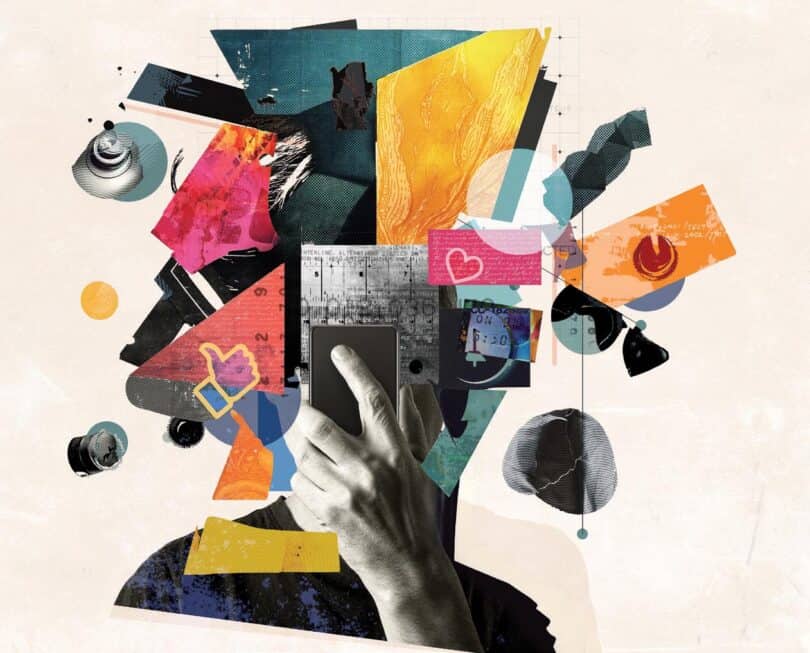
See if this seems familiar. You lose a word mid-sentence. Read the same paragraph twice. Feel mentally tired long before the day is over. Get distracted easily when you used to be able to focus. Many of us are quietly wondering the same thing: is something wrong with my brain?
Now, how much of this rings true. You listen to music while you make dinner. A podcast plays while you exercise. An all-news station mutters in the background while you respond to emails. You spend an hour on YouTube watching videos when you only meant to watch one or two.
Let’s not forget online games, messaging platforms, texting and oh, yeah, there’s also work.
And while you’re online, up pop quizzes, surveys and provocative questions about your mental health. “Do THIS to Keep Your Brain Young!” “One Simple Trick to Avoid Cognitive Decline!” “Play this Game Twice a Day to Think Young Again!”
It’s entirely possible that intermittent blips in our thinking are the result of taking in too much information. Struggling to concentrate isn’t a diagnosis, it’s a symptom, and it might be more situational than medical. This isn’t about just screen time; it’s about the mental power it takes to process all that data.
Why are so many people in their 30s, 40s, 50s and 60s getting a diagnosis of ADHD? They are overloaded and overstimulated.
DAMIAN DEVONISH,
Integration Psychotherapy Services
According to the Centre for Addiction and Mental Health (CAMH), one in five Canadians experience mental illness each year. Not to downplay that statistic, but that also means four out of five do not. And yet it often seems like people are blaming occasional forgetfulness on an undiagnosed mental health condition as if it were a fact.
It All Goes to Your Head
There’s an important question buried beneath all this concern: are our brains actually failing, or are they simply overloaded? And how do we separate the mental health wheat from so much online chaff.
Attention Deficit/Hyperactivity Disorder (ADHD) is typified by fidgeting, forgetfulness, an inability to concentrate and other symptoms. Diagnoses have spiked in the last five years, according to Damian Devonish of Integration Psychotherapy Services.
“We have had a 54 per cent increase in adults being diagnosed with ADHD,” Devonish explains. “And if your first response is that it’s shocking, that is correct. Why are so many people in their 30s, 40s, 50s and 60s getting a diagnosis of ADHD? They are overloaded and overstimulated.”
We push ourselves to do more when, Devonish says, we ought to be doing less. His advice applies to children, too.
“They always need a stimulant,” Devonish says. “Anytime stillness is required it’s interpreted in the brain as being bored. That’s the child’s equivalent of, ‘I am addicted.’”
Many experts think periods of boredom are not only beneficial, but they also give our brains a chance to recalibrate and recover from overload. And Devonish says silence and genuine rest, not an activity-filled vacation, are necessary to fuel creativity.
Bored Out of Your Mind
Neuroscientist Dr. Eric Haseltine writes in Psychology Today that our brains are wired to “seek novelty and avoid boredom.” But instead of feeling like you’re wasting time, Dr. Haseltine recommends using those bored periods to reconnect with people face to face and indulge in other low-tech activities like reading an actual book, instead of going back online.
He writes, “Hyper-stimulation is to our mood what donuts are to our waistlines.”
One of our biggest concerns surrounding mental health centres on preserving future brain power. Many people genuinely fear developing dementia, especially if they’ve had firsthand experience with a loved one whose life slowly eroded. They worry that occasional forgetfulness is a harbinger of what’s to come.
A caregiver explained it to me this way: “If you forget your keys, you’re likely just having a moment. If you forget what keys are for, you should look into that further.”
That’s a generalization, of course, and any concerns should be addressed by a qualified doctor. However, seeing constant click-bait ads and so-called cognitive tests online keep this worry top of mind where it probably doesn’t need to be.
Less is More
Humans are navigating more information, noise and responsibility than ever before. Our brains process as much as 74 gigabytes (GB) of information every day. That would be a lifetime’s worth for someone living 500 years ago. Feeling mentally scattered in this environment might say less about an individual brain and more about the conditions it’s operating in. We’re so used to it that any attempt to create mental space seems like slacking off.
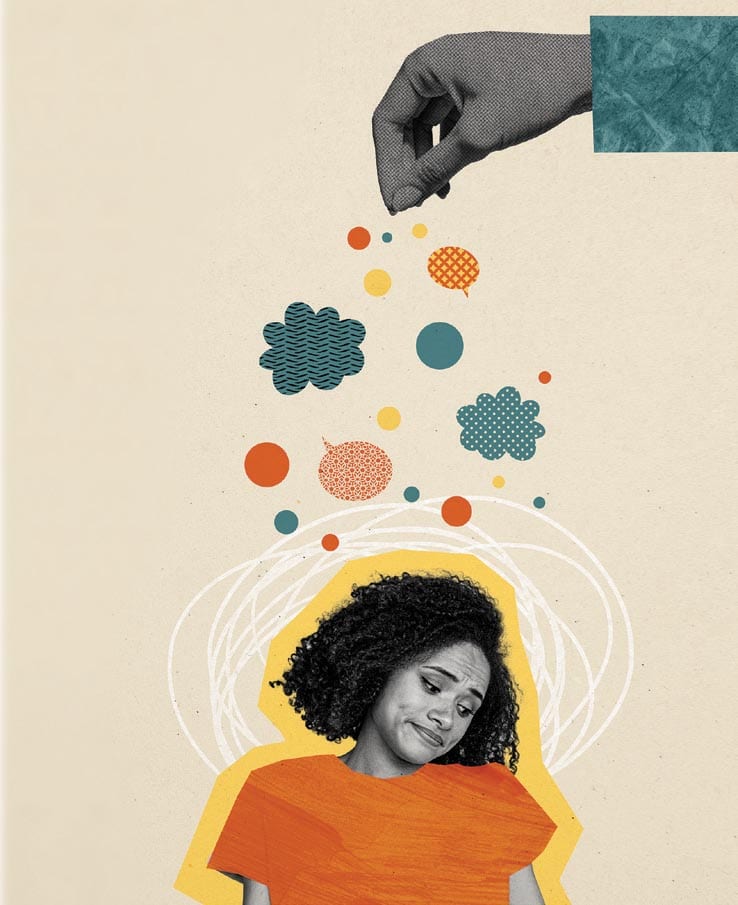
Our brains process as much as 74 gigabytes (GB) of information every day. That would be a lifetime’s worth for someone living 500 years ago.
If you’ve ever streamed a show while pecking away on a keyboard, you’re familiar with the concept of multi-tasking. However, in recent years the very idea of multitasking has been debunked. It turns out the brain can only concentrate on one thing at a time. When you split your attention, it’s called task switching.
We end up devoting less attention to each chore instead of doing them well, one at a time. Through clicking and operating in the digital world, we’ve literally been trained to be less able to focus on just one thing.
The Social Connection
Meanwhile, all-or-nothing social media influencers are full of advice to make immediate and drastic lifestyle changes to slow things down so our brains can catch up. But a complete social media or Internet detox simply isn’t realistic for many people, no matter how much going cold turkey sounds like a beach vacation for the brain.
Devonish advises that if time spent on Facebook, Instagram and the like is clogging your thoughts, you have a decision to make.
“We don’t have to be on social media,” he explains. “If I really feel I need these connectors, there’s someone out there who loves social media and I will pay them to do it. There’s always an option and we should choose the option that gives us the best quality of life.”
Cassie Vivyurka, owner of Vivify Social Media, is one of those people who takes the burden off her clients.
“Even for someone like me who loves social media, it can be hard on mental health,” says Vivyurka. “We always have to keep up with the latest trends as well as engage with our followers almost the second we post something, so it’s easy to get caught up online. I’m organized in such a way that I focus on one task at a time which helps to not mindlessly scroll.”

She explains she has also prioritized notifications to be more efficient with her time.
“For example, I don’t have the likes turned on but I do have message notifications on. I’m not bombarded by each like but I will see messages come through since those are usually more important and timely.”
A fundamental way to help the brain is by laying a solid foundation with proper sleep, a healthy diet, and social time with family and friends.
Take It to the Limit
Restrictions can be applied to any type of notifications, from text messages to emails. Twenty-four/seven access is something we are accustomed to, but there are few truly urgent matters.
A fundamental way to help the brain is by laying a solid foundation with proper sleep, a healthy diet, and social time with family and friends. A night out or an afternoon off to do something fun is practically a medical need for our mental health, although I wouldn’t try to submit movie ticket stubs on an expense report.
Serious neurological and mental health conditions do exist, of course, and they deserve proper diagnosis and care. But not every lapse in focus or memory is a warning sign. Understanding what is cause for concern, what is being overstated, and what genuinely helps protect brain health can replace anxiety with clarity. And it might save enough brain power to bring you that word when you need it.